


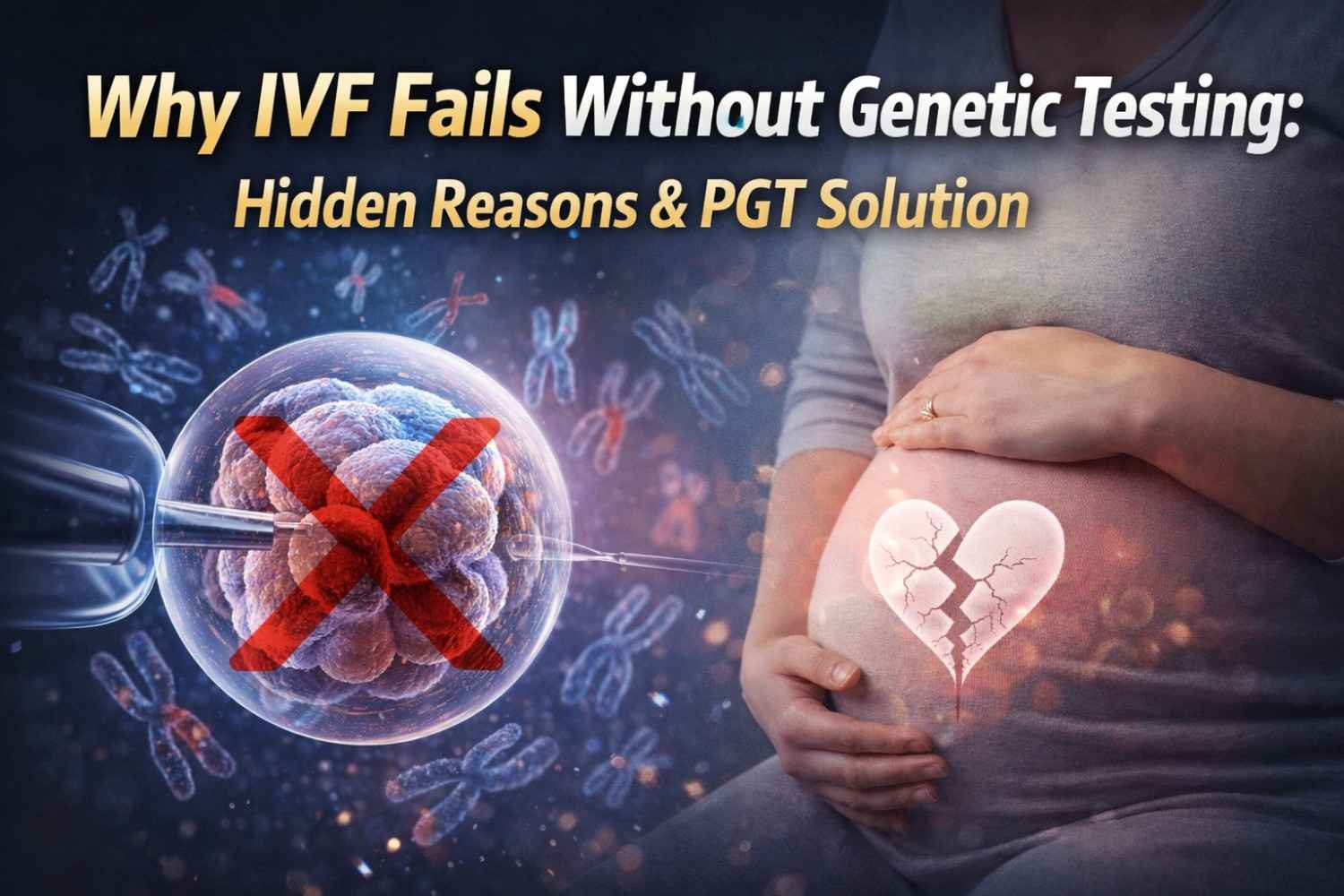
Why IVF fails without genetic testing is often linked to hidden chromosomal problems in embryos that cannot be detected by appearance alone. Going through an IVF cycle is an emotional and financial marathon. You’ve done the injections, the scans, and the egg retrieval, only to receive the heartbreaking news that the embryo didn’t implant or that the pregnancy ended in a mirror-shattering early loss.
When this happens, the first question is always: Why?
From what I’ve seen in the fertility space, one of the most common reasons for a “perfect-looking” embryo failing to result in a baby isn’t the mother’s uterus or the doctor’s technique—it’s the internal blueprint of the embryo itself. This is where genetic testing changes the game. This guide is for anyone who has faced a failed cycle or is planning their first one and wants to understand how to maximize their odds from day one.
IVF Failure Causes: Genetic Issues
Many people are surprised to learn that an embryo can look “Grade A” under a microscope but be biologically incapable of becoming a baby. In my experience, the leading cause of IVF failure is aneuploidy—a fancy word for an embryo having the wrong number of chromosomes.
Even in healthy young couples, a significant percentage of embryos naturally have chromosomal abnormalities. As we age, this percentage climbs steeply.
-
The “Invisible” Barrier: An embryo with an extra or missing chromosome might grow well in the lab for five days, but once transferred, the body usually recognizes the error and stops the pregnancy.
-
The Result: This manifests as a “chemical pregnancy,” a flat-out negative test, or a miscarriage in the first trimester.
Read This Also: Genetic Testing in IVF (PGT-A, PGT-M): Full Guide Before Embryo Transfer
How PGT Helps IVF Success Rate
Preimplantation Genetic Testing (PGT) acts like a high-definition filter. Instead of your doctor “guessing” which embryo is best based on how it looks, they can know which one is healthy based on its DNA.
In 2026, the data is clearer than ever: how PGT helps IVF success rate is by shortening the “time to pregnancy.” By only transferring “euploid” (chromosomally normal) embryos, we see:
-
Higher Implantation Rates: A screened embryo has a significantly higher chance of sticking.
- Reduced Miscarriages: You’re not transferring embryos which genetically programmed to fail.
- Confidence in One Embryo Transfer: You can safely transfer just one embryo without the risk of having twins yet still have very high success rates.
Genetic Testing for IVF
Genetic testing for IVF has moved on from being a bonus to becoming a key component.
It isn’t just about screening for Down Syndrome; it’s about understanding why fertilization might be happening but pregnancy isn’t.
Think of it as a quality control check. Without it, you might spend three cycles transferring embryos that never had a chance. With it, you focus all your energy and resources on the candidates with the highest potential.
When Should Doctors Suggest PGT-A or PGT-M During IVF?
It is not necessary for everyone to undergo genetic screening; however, for specific individuals, it is a necessity. Here is a guide on when should doctors suggest PGT-A or PGT-M during IVF:
PGT-A (Aneuploidy Testing)
This is the most common test and involves chromosome counting. It is suggested in the following cases:
Advanced Maternal Age: If the female patient is above 35 years.
Recurrent Miscarriage: For patients who have experienced at least two pregnancy losses.
IVF Failure: If previous “good” embryos did not result in pregnancy.
PGT-M (Monogenic/Single Gene Testing)
This is a focused search.
It is recommended when:
-
One or both parents are carriers of a specific genetic disorder (like Cystic Fibrosis or Sickle Cell Anemia).
-
You want to ensure the condition is not passed down to your child.
Read This Also: Oppo F33 Pro Review: This Phone Will Shock You! 7000mAh Battery
PGT Testing Benefits in IVF: A Practical Comparison
If you are weighing the costs, consider the “efficiency” of your journey. I often tell patients to look at the “cost per live birth” rather than “cost per cycle.”
| Factor | Without PGT Testing | With PGT Testing |
| Selection Criteria | Visual “grading” (Appearance) | Genetic “blueprinting” (DNA) |
| Miscarriage Risk | Higher (especially over age 35) | Significantly Reduced |
| Time to Pregnancy | Potentially longer (multiple transfers) | Usually faster (higher hit rate) |
| Emotional Toll | Higher due to unexpected failures | More “predictable” outcomes |
Real-Life Mistake: Rushing the Transfer
One of the biggest mistakes I see is couples being so eager to reach the transfer stage that they skip testing to “save time” or “save money.”
-
The Problem: You transfer an untested embryo, it fails, and you spend three months recovering emotionally and physically before you can try again.
-
The Fix: Use the “Freeze-All” strategy. Biopsy the embryos, freeze them, and wait for the results. This also gives your body time to recover from the retrieval hormones, creating a more receptive environment for the embryo.
Summary & Takeaway
IVF fails for many reasons, but genetic “noise” is the most frequent culprit. While PGT isn’t a 100% guarantee of a baby, it removes the biggest hurdle standing in your way. If you are over 35 or have faced the pain of a failed transfer, genetic testing isn’t just an “add-on”—it’s the roadmap to your success.
FAQs
1. Does the biopsy hurt the embryo?
In modern 2026 labs, we use niPGT (non-invasive) or highly skilled laser biopsies on Day 5 (blastocyst stage). At this stage, we only take cells from the part that becomes the placenta, leaving the “inner cell mass” (the baby) untouched. The risk to a healthy embryo is extremely low (less than 1%).
2. Can PGT fix an abnormal embryo?
No. PGT is a screening tool, not a repair kit. It helps us identify the healthy ones, but it cannot change the genetics of an abnormal one.
3. If my embryos are PGT-normal, am I guaranteed a baby?
Not quite. While it raises the odds to roughly 65-70% per transfer, other factors like uterine lining, progesterone levels, and immune response still play a role.
4. Is PGT-A the same as “Gender Selection”?
Technically, PGT-A does reveal the sex chromosomes (XX or XY). However, in many countries (like India), using this for gender selection is strictly illegal. The primary goal is always health and viability.
5. How long do PGT results take?
Usually, you’ll have your report within 7 to 14 days after the embryos reach the blastocyst stage.
6. Is it worth the extra cost?
If it prevents even one failed transfer or miscarriage, most patients find it is worth the investment both financially and for their mental health.