

1 Month Pregnancy Symptoms: The first month of pregnancy is often a time of quiet mystery. For many women, it starts not with a positive test, but with a “feeling.” You might find yourself staring at your coffee and suddenly finding the smell unbearable, or perhaps you’re so exhausted that you fell asleep on the sofa at 7:00 PM.
If you are reading this, you are likely in that “waiting room” phase—wondering if these subtle shifts in your body are just PMS or the beginning of a forty-week journey. I’ve spoken with countless women and tracked these early transitions, and if there is one thing I’ve learned, it’s that no two first months are the same. This article is for those who want to look beyond the clinical definitions and understand the practical, day-to-day reality of very early pregnancy.
The “Invisible” Timeline: Week 1 to Week 4
Technically, the first two weeks of a “one-month pregnancy” you aren’t even pregnant yet. Doctors count from the first day of your last period. By the time you reach week four—the time your period is actually due—the tiny cluster of cells has just implanted.
From experience, this is when the hormonal “soup” begins to simmer. Progesterone levels spike to support the pregnancy, and it’s this specific hormone that causes most of the symptoms people mistake for a heavy period or a flu.
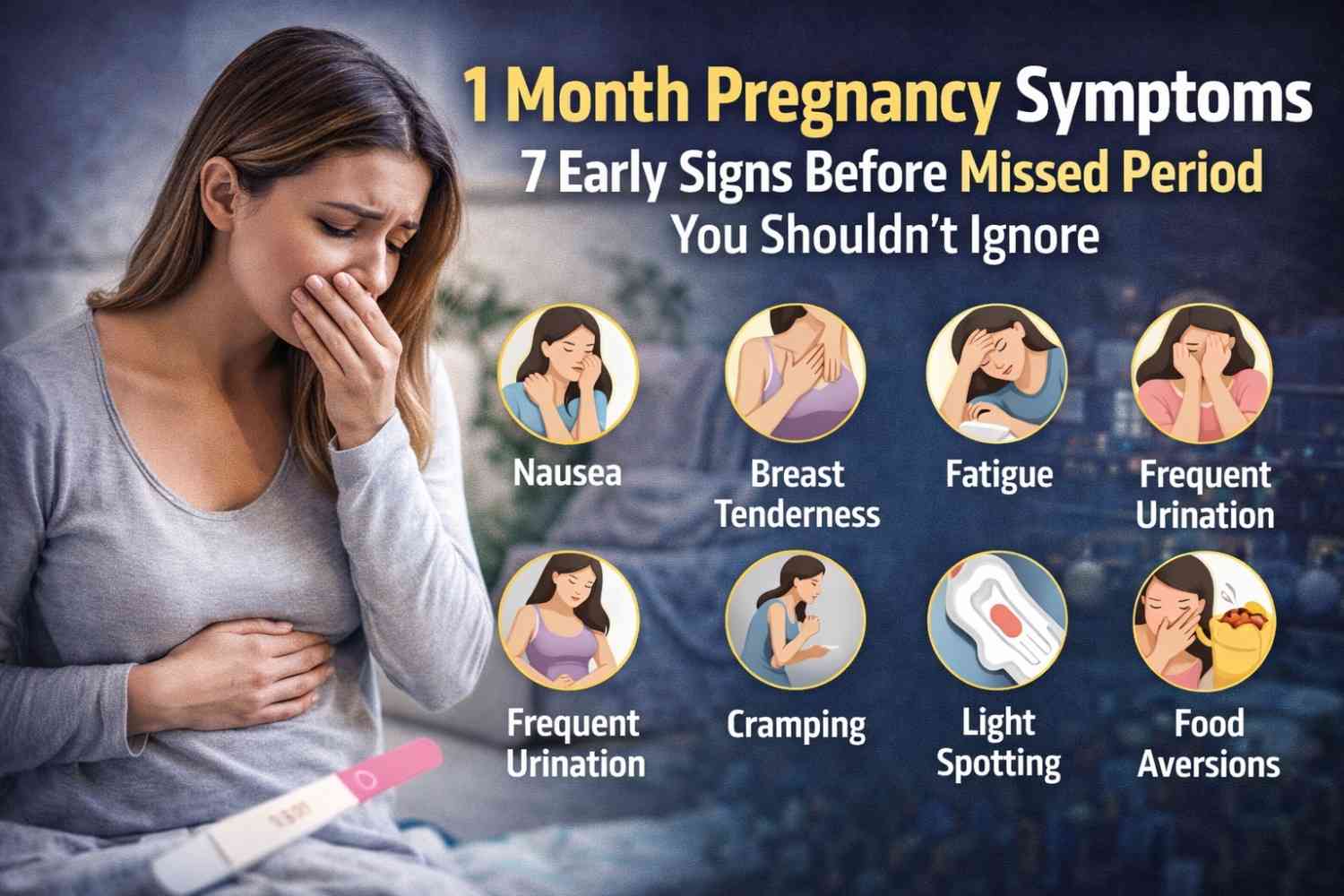
1 Month Pregnancy Symptoms You Might Notice Before a Missed Period
1. The Unusual Fatigue
This isn’t just “I stayed up too late” tired. It’s an overwhelming, heavy exhaustion. Your body is working overtime to build the placenta and increase blood production. I’ve seen many women describe it as feeling like they are “coming down with something.” If you find yourself needing a nap just to get through lunch, take note.
2. Breast Changes and Sensitivity
While breast tenderness is a common PMS symptom, pregnancy-related changes often feel more intense. You might notice your breasts feel fuller, heavier, or that the area around the nipples (the areola) looks darker or bumpier. For some, even the friction of a t-shirt becomes annoying.
3. Implantation Spotting
About 10 to 14 days after conception, you might see very light pink or brown spotting. This is often confused with the start of a period. However, implantation bleeding is typically very scant and doesn’t last more than a day or two.
4. The Famous “Morning Sickness” (Which Isn’t Just in the Morning)
Nausea usually kicks in around week six, but some women feel “queasy” or “off” as early as week four. It might be triggered by certain smells—like frying oil, perfume, or even your favorite shampoo.
Read This Also: Mom Burnout Is Real: 7 Warning Signs You Shouldn’t Ignore
1 Month Pregnancy Symptoms: Real-Life Mistakes and Easy Fixes
When those first symptoms hit, it’s easy to panic or misinterpret what’s happening. Here are a few common hiccups I’ve observed:
| Mistake | Why it happens | The Fix |
| Testing too early | Anxiety to know the result immediately. | Wait until the day of your missed period for a reliable “fatigue-free” result. |
| Ignoring the “flu” feeling | Progesterone can raise body temp slightly. | Check your temperature; if it stays elevated for 18+ days after ovulation, it’s a strong sign. |
| Over-caffeinating to fight fatigue | Trying to maintain a busy work schedule. | Switch to herbal tea or water. Excess caffeine isn’t ideal in early pregnancy anyway. |
| Dismissing “Cramps” | Assuming a period is coming. | Early pregnancy cramps feel like pulling or stretching rather than heavy aching. |
A Practical Routine for Your First Month
If you suspect you are pregnant, your “workflow” needs to shift from high-gear to self-care. Here is a simple system to follow while you wait for that second line on the test:
-
Hydration First: Start drinking more water than usual. Your blood volume is increasing, and hydration helps ease the early headaches that many women face.
-
Gentle Movement: If you’re feeling bloated or crampy, don’t stop moving entirely. A 20-minute walk can help regulate your digestion, which often slows down due to hormones.
-
Start a Prenatal Vitamin: Even before a confirmed test, if you are “trying,” a folic acid supplement is essential for the baby’s neural tube development in these very first weeks.
-
Listen to Your Nose: If a certain food makes you gag, don’t force it. Your body is incredibly good at “gatekeeping” what it needs right now.
Checklist: Is It PMS or Pregnancy?
Check these off to see where you stand. While not a diagnosis, these are the hallmarks of a 1-month pregnancy:
-
Basal Body Temperature: Is your temperature consistently higher than usual?
-
The “Metal” Taste: Do you have a weird, metallic taste (dysgeusia) in your mouth?
-
Frequency of Urination: Are you headed to the bathroom more often, even if you haven’t increased your water intake?
-
Mood Swings: Do you feel unusually weepy or irritable over things that normally wouldn’t bother you?
-
Missed Period: This remains the most reliable physical indicator.
Read This Also: OPPO F33 Pro: IP69K Waterproof Phone with 7000mAh Battery
1 Month Pregnancy Symptoms : Summary and Takeaway
The first month of pregnancy is a subtle transition. Your body is essentially performing a massive “background update.” While the symptoms—fatigue, nausea, and breast tenderness—can be uncomfortable, they are also signs that your hormones are doing exactly what they are supposed to do.
If you suspect you’re pregnant, the best thing you can do is breathe, slow down, and wait for that missed period to take a high-quality home test. Trust your intuition; you know your body better than any chart.
FAQs:
1. What are 1 month pregnancy symptoms?
In case of pregnancy at 1 month, one can experience some pregnancy symptoms such as tiredness, breast soreness, cramping, and nausea.
2. Can I get pregnancy symptoms at 1 month?
Yes, there are some pregnancy symptoms that one experiences during 1 month pregnancy because of hormone imbalance. Women may experience tiredness, bloating, and a weird metallic taste before a missed period.
3. Is spotting common during 1 month pregnancy?
Yes, light spotting may occur during 1 month pregnancy due to implantation. The spotting is brownish or pink-colored.
4. When should I take the pregnancy test when experiencing 1 month pregnancy symptoms?
In case one experiences 1 month pregnancy symptoms, one needs to wait until missing a period before taking the test to ensure accurate results.
5. Can cramping occur during 1 month pregnancy symptoms?
Yes, cramping is common during 1 month pregnancy. Cramping during this period occurs because of mild pulling or stretching, not heavy menstrual cramps.