


If you’re searching “what is IVF” and “IVF cost in India,” you’re probably trying to solve a very real problem: you want a clear plan and a realistic budget, not a confusing mix of medical terms and price promises.
I’ve seen most people get stuck in the same two places:
-
They don’t understand what actually happens step-by-step, so every test feels scary.
-
They hear “IVF starts from ₹X” and later discover medicines, lab steps, and add-ons can change the final bill.
This guide is for couples in India and also for people in the US/UK considering treatment in India.
What IVF actually is (in simple words)
IVF (In Vitro Fertilization) means fertilization happens outside the body in a lab. Eggs are collected from the ovaries, sperm is prepared, fertilization happens in controlled conditions, and then an embryo is placed back into the uterus.
IVF is commonly considered when:
-
Tubes are blocked or damaged
-
Low sperm count/motility or other male-factor issues
-
Endometriosis or PCOS affecting ovulation
-
Unexplained infertility
-
Age-related fertility decline
-
Multiple failed IUI cycles
Why this matters: IVF isn’t “one procedure.” It’s a workflow with decisions at each step. Understanding the workflow helps you avoid rushed choices.
The IVF process: step-by-step (what happens and why it matters)
1) Initial evaluation (both partners)
Typical steps include blood tests, ultrasound, semen analysis, and sometimes uterine/tube checks.
Why it matters: IVF outcomes depend on basics—egg reserve, sperm quality, uterine health. Skipping a thorough work-up can waste a cycle.
2) Ovarian stimulation (10–14 days, usually)
You take hormone injections to grow multiple follicles (eggs).
You’ll have 2–4 monitoring visits (scan + hormone tests).
Why it matters: The dose is not “standard.” It’s adjusted based on response. Too little can mean fewer eggs; too much can raise risk of OHSS (your doctor will watch for this).
3) Trigger shot
A “trigger” injection is timed to mature eggs before retrieval.
Why it matters: Timing is everything. A badly timed trigger can reduce mature eggs.
4) Egg retrieval (short procedure)
Done under sedation/anaesthesia; eggs are collected using ultrasound guidance.
Real-world note: Most people are okay the same day, but plan for rest for 24–48 hours.
5) Sperm collection and lab fertilization (IVF or ICSI)
-
Conventional IVF: eggs and sperm are placed together.
-
ICSI: a single sperm is injected into the egg (often used in male-factor infertility).
Why it matters: Clinics may recommend ICSI quickly. Sometimes it’s appropriate; sometimes it’s “default.” Ask why.
6) Embryo development (Day 3 or Day 5)
Embryos are grown and monitored in the lab.
-
Day 3 transfer: earlier stage
-
Day 5 (blastocyst) transfer: more developed stage
Why it matters: Day 5 can help selection, but not everyone reaches day 5. The decision should match your case.
7) Embryo transfer (fresh or frozen)
-
Fresh transfer: same cycle as retrieval
-
Frozen embryo transfer (FET): embryos are frozen; transfer happens later
Why it matters: Many clinics prefer FET for better uterine timing or if hormone levels are high.
8) Luteal support + pregnancy test
You’ll take progesterone support and test after ~10–14 days.
Why it matters: The two-week wait is stressful; plan emotional support and avoid over-testing too early.
IVF cost in India: what you’re really paying for
IVF pricing varies based on:
-
Medicines required (often a big swing)
-
ICSI, blastocyst culture, embryo freezing, FET
-
Additional testing (PGT, hysteroscopy, etc.)
-
Donor egg/sperm or surrogacy (separate cost category)
Important: Any “exact” number without your scan results and medication plan is usually incomplete. I recommend asking for a written estimate that lists what’s included and what’s extra.
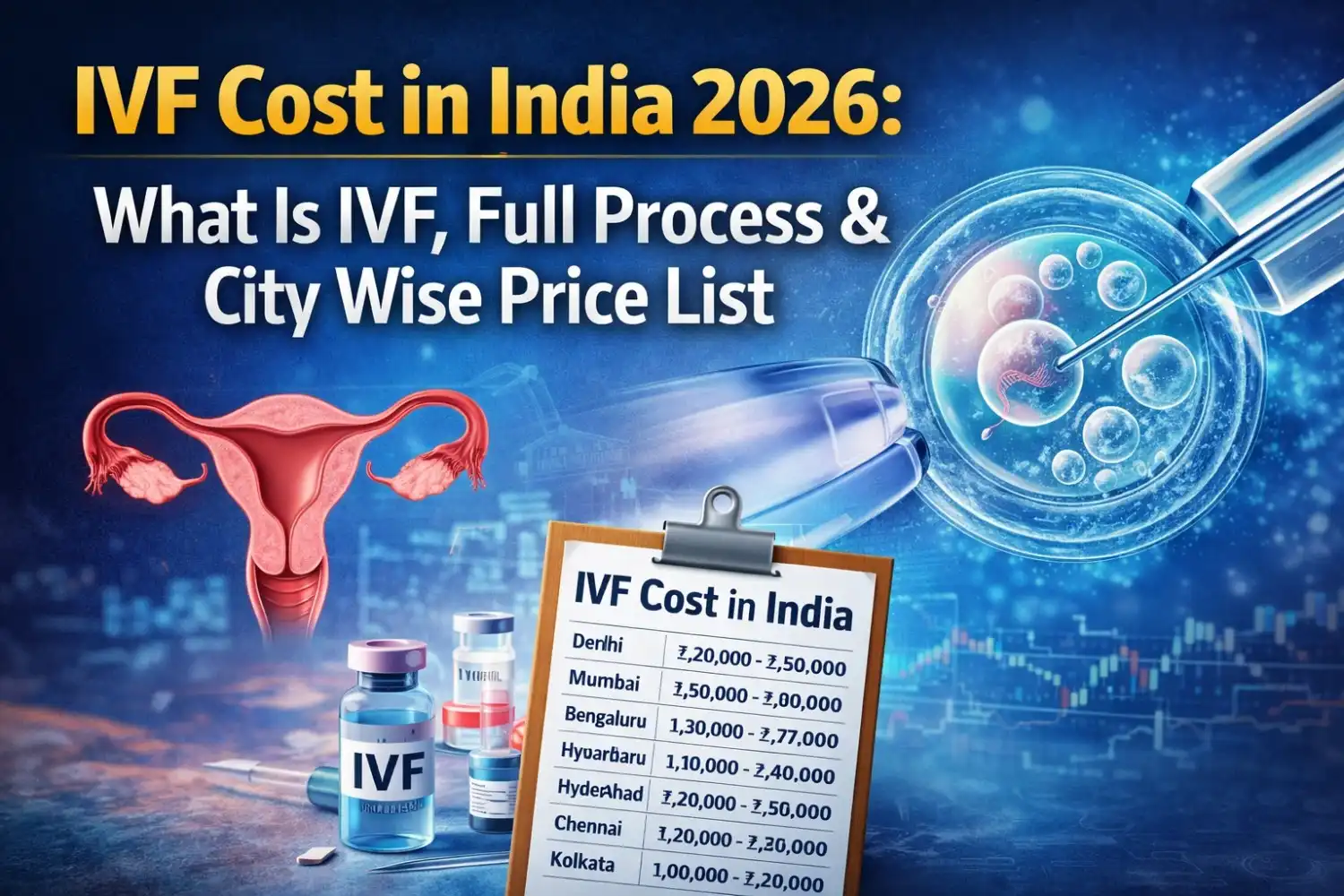
City-wise IVF cost in India
These are common ballpark ranges I see clinics quote. They can vary widely by clinic, case complexity, and medicine dosage.
| City | Typical IVF Cycle Cost Range (₹) | Often Included | Common Add-Ons That Change Price |
|---|---|---|---|
| Delhi NCR | 1,20,000 – 2,50,000 | Consults, monitoring, egg retrieval, lab IVF | ICSI, freezing, FET, extra lab culture |
| Mumbai | 1,50,000 – 3,00,000 | Core cycle steps | Higher lab/OT fees, medicines can push totals |
| Bengaluru | 1,30,000 – 2,70,000 | Core cycle steps | ICSI, blastocyst, freezing, FET |
| Hyderabad | 1,10,000 – 2,40,000 | Core cycle steps | Similar add-ons; package rules vary |
| Chennai | 1,20,000 – 2,50,000 | Core cycle steps | Lab upgrades and freezing/FET |
| Pune | 1,20,000 – 2,40,000 | Core cycle steps | ICSI and medicine cost swings |
| Kolkata | 1,00,000 – 2,20,000 | Core cycle steps | Add-ons + medicines |
| Ahmedabad | 95,000 – 2,10,000 | Core cycle steps | Often competitive pricing; ask about labs |
| Jaipur | 90,000 – 2,00,000 | Core cycle steps | Check what’s excluded (meds/testing) |
| Kochi | 1,00,000 – 2,20,000 | Core cycle steps | Similar add-ons |
Package tip: Some clinics quote “IVF package” but exclude injections/medicines, freezing, or embryo transfer. Always confirm.
A practical IVF budgeting checklist (use this before you pay)
Ask for these items in writing:
-
What does the base package include (retrieval + lab + transfer)?
-
Are medicines included? If not, estimated medicine range?
-
Is ICSI included or separate?
-
Is embryo freezing included? Storage cost per year?
-
Is FET included if doctor advises frozen transfer?
-
What tests are required and approximate cost?
-
Refund/transfer policy if cycle is canceled (poor response, OHSS risk)
-
Cost of additional visits or scans beyond the included number
Common real-life mistakes I see (and how to avoid them)
Mistake 1: Choosing based on the cheapest “starting price.”
Fix: Compare total expected cost (base + meds + likely add-ons).
Mistake 2: Not asking the lab questions.
Fix: Ask about embryology lab experience, culture practices, and how many embryos typically reach transfer in cases like yours (no promises—just approach).
Mistake 3: Not planning time off.
Fix: Keep 2–3 flexible days around retrieval and transfer. Stress and travel fatigue don’t help.
Mistake 4: Ignoring lifestyle basics.
Fix: Sleep, nutrition, reduced alcohol/smoking, and managing chronic conditions can improve preparedness—especially over 6–8 weeks.
Takeaway
IVF is a structured process with decisions at every stage—tests, stimulation, lab method, and transfer strategy. The best outcomes usually come from good medical fit + transparent costing + calm planning, not from rushing into the first “package deal.”
FAQs (real doubts people ask)
-
Is IVF painful?
Most discomfort is from injections and bloating. Egg retrieval is usually under sedation. -
How long does one IVF cycle take?
Commonly 4–6 weeks from evaluation to pregnancy test, depending on whether it’s fresh transfer or FET. -
What’s the biggest hidden cost in IVF?
Medicines and add-ons like ICSI, freezing, and FET. -
Is ICSI necessary for everyone?
No. It’s common with male-factor infertility, but you should ask why it’s recommended for you. -
Fresh transfer vs frozen transfer—what’s better?
It depends on hormone levels, uterine lining, and your case. Many clinics do FET for better timing. -
Can IVF guarantee pregnancy?
No. IVF improves chances, but outcomes depend on age, egg/sperm quality, embryo development, and uterine factors. -
If I’m from the US/UK, how should I plan IVF in India?
Plan for at least 3–4 weeks in India for a full cycle. Some choose embryo creation in India and later FET with fewer travel days. -
How do I choose the right IVF clinic?
Look for transparent billing, clear communication, individualized protocols, and a strong lab team—not marketing claims.