


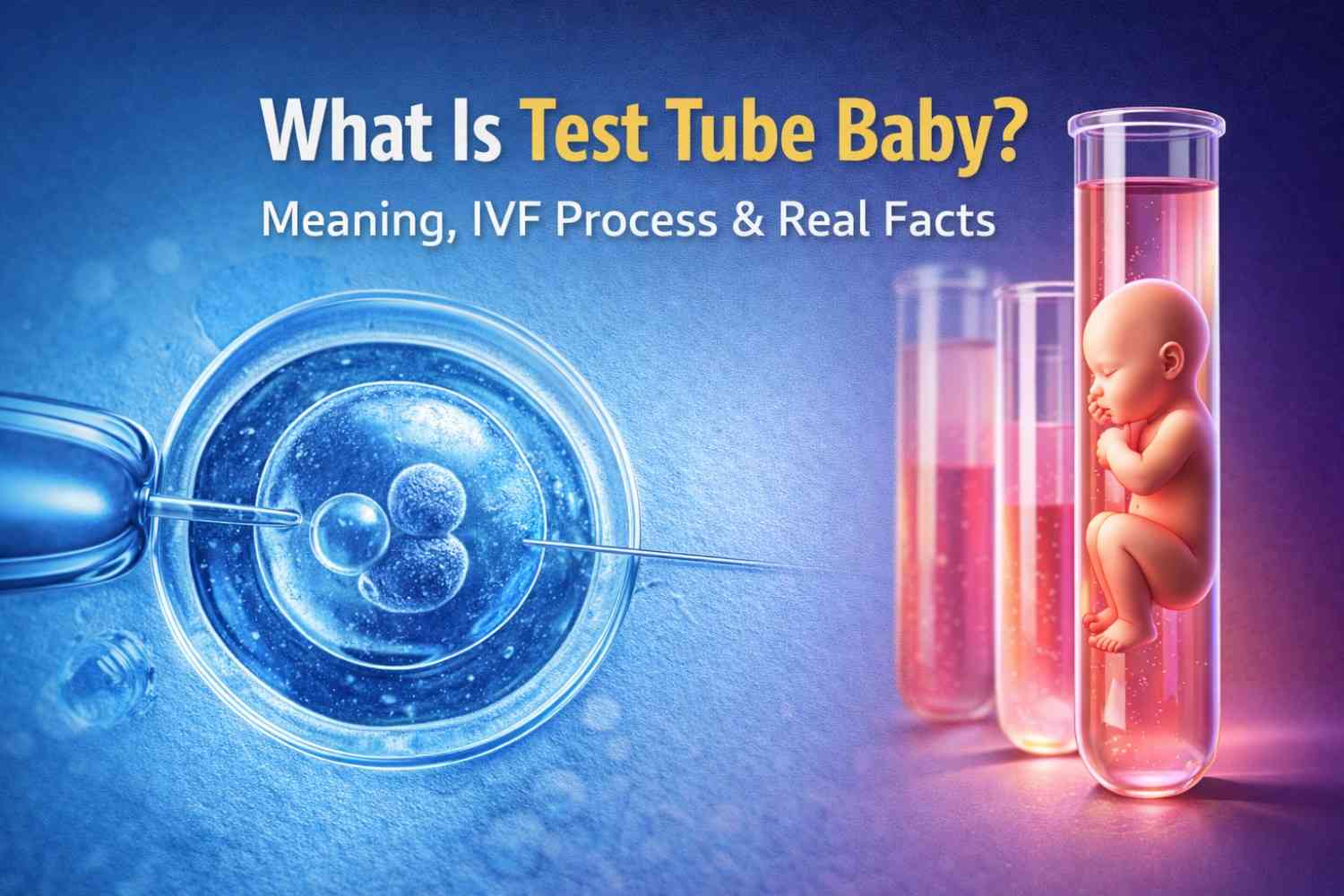
What Is Test Tube Baby?: If you’re searching “test tube baby,” you’re usually trying to understand something very specific: what it actually means, what happens step by step, what it feels like in real life, and what decisions you’ll face before you even start.
In the US and UK, “test tube baby” is a common phrase, but the medical term is IVF (In Vitro Fertilisation). Most of the process doesn’t happen in a test tube. It happens in a fertility lab using specialised dishes and incubators, and then (if all goes well) an embryo is placed back into the uterus.
Read This Also: IVF Treatment Risks and Side Effects – What No One Tells You
I’ll explain IVF in plain language, with practical details people often don’t tell you upfront—what to expect, where things can go off-track, and how to prepare.
What Is Test Tube Baby? “Test Tube Baby” Meaning in Simple Words
A “test tube baby” is a baby conceived through IVF, where:
-
Eggs are collected from the ovaries.
-
Eggs and sperm are combined in a lab to create embryos.
-
One embryo (sometimes more, depending on the plan) is transferred into the uterus.
-
If the embryo implants and grows, pregnancy continues as usual.
Important clarity: IVF helps with conception. It doesn’t guarantee a baby. Sometimes IVF leads to pregnancy quickly; other times it takes multiple attempts or a change in strategy.
When People Usually Consider IVF
In practice, IVF is often considered when:
-
Fallopian tubes are blocked/damaged (sperm can’t meet egg naturally).
-
Severe male-factor infertility (low count, motility, or morphology).
-
Ovulation issues that don’t respond well to simpler treatments.
-
Endometriosis affecting fertility (varies person to person).
-
Unexplained infertility after testing looks “normal.”
-
Age-related fertility decline, where time matters.
-
Genetic concerns, where testing embryos may be discussed.
-
Same-sex couples or single parents using donor sperm/eggs and/or a gestational carrier.
A good clinic will explain why IVF fits your situation and whether simpler options are worth trying first (like medication + timed intercourse or IUI).
The IVF Process Step by Step (What Actually Happens)
1) Initial assessment and planning
You typically start with:
-
Hormone blood tests
-
Ultrasound (to look at ovaries and uterus)
-
Semen analysis
-
Sometimes a tubal test or uterine cavity check
Why this matters: IVF isn’t one-size-fits-all. Medication doses, timing, and lab decisions depend on your baseline.
Read This Also:Vivo V70 Series Launch Date in India, Price & Full Specs Revealed
2) Ovarian stimulation (10–14 days, often)
Instead of releasing one egg, you take injections to mature multiple follicles.
You’ll have monitoring visits every few days:
-
Ultrasounds to measure follicles
-
Blood tests to track hormone levels
Real-world note: The emotional load here is real—frequent appointments, waiting for “good numbers,” adjusting doses, and feeling like your life revolves around a calendar.
3) Trigger shot (final maturation)
When follicles are ready, you take a “trigger” injection to finalise egg maturation. Timing is strict.
Why it matters: Egg retrieval is scheduled around the trigger. A mistimed trigger can affect outcomes.
4) Egg retrieval (procedure day)
Egg retrieval is usually done with sedation. A needle guided by ultrasound collects eggs from the follicles.
Afterwards you may feel:
-
cramping
-
bloating
-
fatigue
Practical tip: Plan a quiet day and the next day lighter if possible.
5) Fertilisation in the lab (IVF or ICSI)
Eggs are fertilised by:
-
Conventional IVF: sperm and eggs placed together
-
ICSI: a single sperm injected into each egg (often used for male-factor issues)
Why it matters: The lab method can be a big decision, especially if sperm quality is borderline.
6) Embryo development (Day 1 to Day 5/6)
Embryos are grown in the lab and monitored. Many clinics aim for blastocyst stage (Day 5/6), but not everyone reaches that point.
Hard truth (said gently): It’s common to start with several eggs and end with fewer embryos than expected. Attrition is normal in IVF.
7) Optional embryo testing (PGT)
Some people consider genetic testing of embryos (often called PGT). This is not “required,” and it’s not right for every case.
If you’re unsure: Ask your clinic what it can and cannot tell you, and what the limitations are. Genetic testing is a complex topic and deserves a proper counseling discussion.
8) Embryo transfer (fresh or frozen)
-
Fresh transfer: embryo placed a few days after retrieval
-
Frozen transfer (FET): embryo frozen and transferred in a later cycle
Transfer itself is usually quick and not very painful—more like a smear test for many people.
Why the timing matters: Some clinics prefer frozen transfers in certain situations (for example, if hormone levels are high or the body needs recovery).
9) The “two-week wait” and pregnancy test
This is often the hardest part emotionally. Clinics advise a specific date for a blood test.
What helps: having a plan for distractions, reducing symptom-spotting, and deciding in advance whether you will home-test or wait for the clinic test.
IVF Stages at a Glance
| Stage | What you do | Typical time | What people feel |
|---|---|---|---|
| Testing & plan | scans + bloodwork + consult | 1–4 weeks | hopeful, overwhelmed |
| Stimulation | daily injections + monitoring | 10–14 days | bloated, emotional swings |
| Trigger + retrieval | timed trigger + procedure | 2 days | cramping, fatigue |
| Lab growth | fertilisation + embryo culture | 5–6 days | waiting, anxious |
| Transfer | embryo placed into uterus | 1 day | cautious optimism |
| Two-week wait | medications + blood test | ~9–14 days | mentally intense |
(Exact timelines vary by clinic and protocol.)
Common Real-Life Mistakes (and How to Avoid Them)
Mistake 1: Underestimating the time commitment
Fix: Treat IVF like a short-term project. Arrange flexible work hours if possible and plan transport for monitoring days.
Mistake 2: Not asking about the clinic’s “plan B”
Fix: Ask: “If the response is low/high, what will you change next cycle?” Good clinics think in pathways, not promises.
Mistake 3: Ignoring the emotional side until it crashes
Fix: Build support early—partner check-ins, a friend who knows key dates, or a counselor familiar with fertility stress.
Mistake 4: Confusing egg count with outcome
Fix: Ask for clarity on what matters in your case (egg quality, sperm factors, uterine issues, etc.). One number rarely tells the full story.
Mistake 5: Not preparing for medication logistics
Fix: Make a simple routine: a dedicated storage spot, alarms, and a printed injection checklist.
IVF Preparation Checklist (Practical)
-
Keep your ID, insurance details (if applicable), and clinic contacts in one place
-
Confirm medication storage requirements (some need refrigeration)
-
Set daily alarms for injections
-
Plan transport for monitoring visits and retrieval day
-
Ask about side effects that require urgent contact (each clinic has guidance)
-
Decide how much you want to share with family/work (boundaries help)
-
Make a “two-week wait” plan (work, routines, distractions)
Takeaway: What “Test Tube Baby” Really Means
A “test tube baby” is simply a baby conceived through IVF—eggs and sperm meet in a lab, embryos are created, and an embryo is transferred to the uterus. The process is structured, medical, and often emotionally demanding, but it’s also one of the most established fertility treatments available.
If you’re considering IVF, the most useful next step isn’t reading endless opinions—it’s getting a clear, personalised plan from a reputable clinic and understanding your specific diagnosis and options.
FAQs
Q1. What Is Test Tube Baby?
What Is Test Tube Baby refers to a baby conceived through IVF where fertilisation happens in a lab before embryo transfer.
Q2. How does What Is Test Tube Baby process work?
The What Is Test Tube Baby process involves egg retrieval, lab fertilisation, embryo development and transfer into the uterus.
Q3. Is What Is Test Tube Baby safe?
IVF is a medically established procedure, but safety and success depend on individual health conditions.
Q4. Is What Is Test Tube Baby painful?
Some injections and egg retrieval may cause mild discomfort, but the process is generally manageable.
Q5. How long does What Is Test Tube Baby treatment take?
A single IVF cycle may take several weeks from medication start to pregnancy testing.