

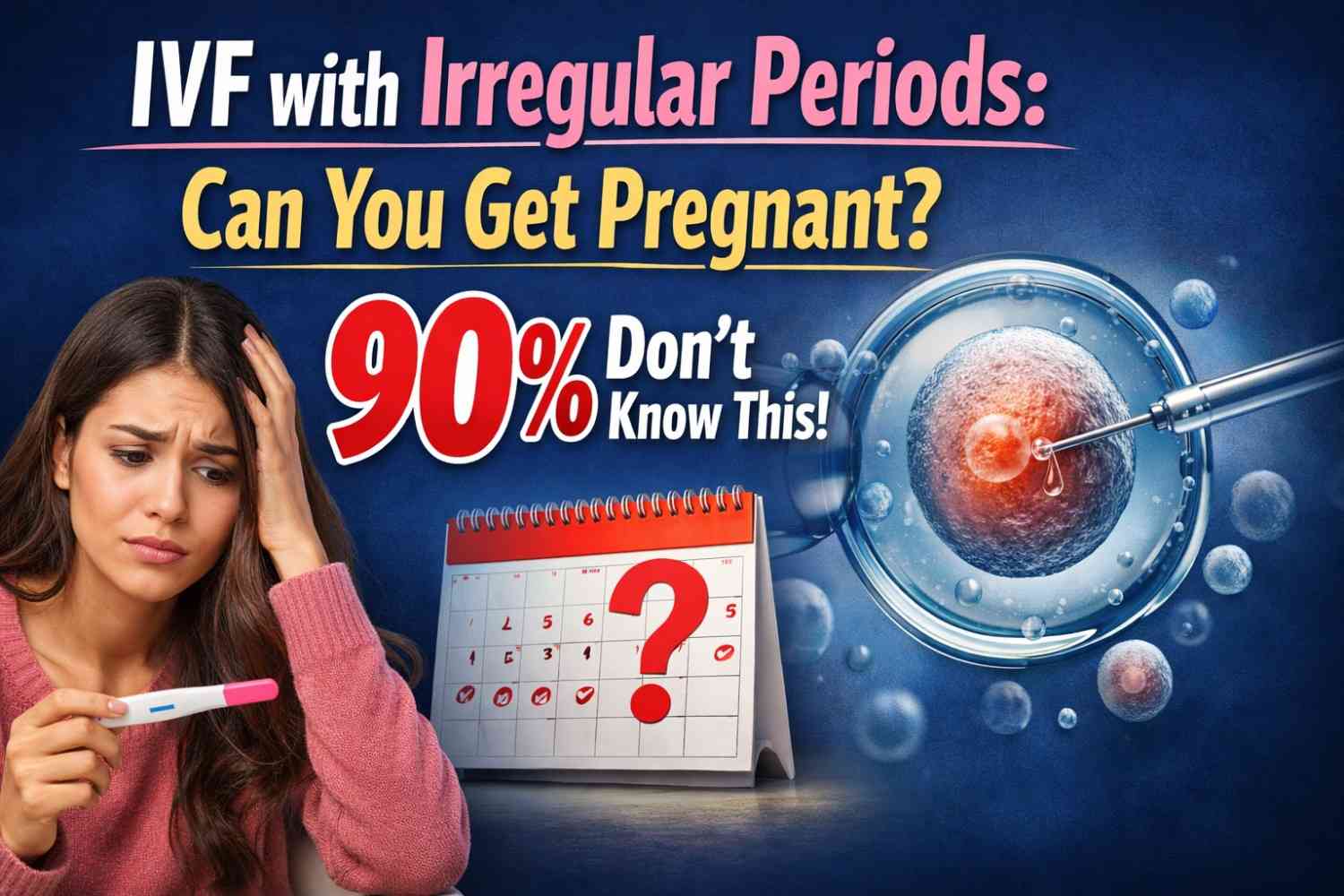
IVF with Irregular Periods: If you’ve been tracking your cycle and seeing 24 days one month and 45 the next, the idea of starting a highly “timed” treatment like IVF can feel overwhelming. I’ve spoken with many women who feel like their bodies are “broken” or that they’re starting the IVF race with a flat tire.
The truth? Irregular periods are one of the most common reasons people turn to IVF, and they are absolutely not a barrier to success. In fact, IVF was designed to solve the very problems that irregular cycles create.
This guide is for anyone who is worried that their unpredictable “Day 1” will ruin their chances of becoming a parent.
The Real Problem: Why Irregularity Feels Scary
In a natural conception journey, irregular periods make it nearly impossible to time intercourse. You’re essentially guessing when the “fertile window” opens. In IVF, the fear is different: “How will the doctor know when to start the meds?” or “What if I don’t ovulate on time for the retrieval?”
From a clinical perspective, IVF actually fixes this by taking the steering wheel away from your natural cycle. We don’t wait for your body to decide when to grow an egg; we use specialized medications to tell it exactly when and how to do so.
Read This Also: Thin Endometrium IVF Solutions: 5 Ways to Improve Lining Fast
Step-by-Step: How IVF “Fixes” an Irregular Cycle
When you have irregular periods, the IVF process usually involves a few extra steps at the beginning to “reset” the system.
-
The “Reset” Phase (Priming)
Before you even start the stimulation injections, most doctors will use Birth Control Pills or Estrogen Priming.
- Why it matters: This might feel counterintuitive (taking a contraceptive when you want to get pregnant!), but it’s brilliant. It suppresses your natural hormones, ensuring all your follicles start at the same size and allowing the clinic to “schedule” your period. It turns an unpredictable cycle into a predictable one.
-
Controlled Ovarian Stimulation
Once your system is quiet, you’ll start daily injections (FSH/LH).
- The Workflow: In a natural irregular cycle, your brain sends “weak” or “confusing” signals to the ovaries. IVF bypasses the brain and sends high-quality signals directly to the ovaries to grow multiple eggs simultaneously.
-
Monitoring via Ultrasound (Not the Calendar)
If your periods are irregular, your doctor won’t rely on a calendar. They will use “Real-Time Tracking.”
- What to expect: You will have ultrasounds every 2–3 days. The doctor is looking at the size of the follicles, not what day of the month it is. This ensures the egg retrieval happens at the exact moment the eggs are mature.
Read This Also: Vivo T5x 5G vs Poco X8 Pro – Don’t Buy Before Watching This!
Real-Life Mistakes vs. Practical Fixes
Navigating IVF with conditions like PCOS or thyroid issues (the usual suspects behind irregular cycles) requires a bit of strategy.
| The Mistake | The Real-World Fix |
| Waiting for a “natural” period to start | Don’t wait forever. If your period is 60+ days late, your doctor can prescribe Progesterone (like Provera) to “induce” a bleed and get the cycle started. |
| Assuming “No Period” = No Eggs | Even if you haven’t bled in months, you likely still have an “ovarian reserve.” IVF can often still find and grow those eggs. |
| Stressing over the “Day 2” start | Most clinics say stimulation starts on Day 2 or 3. If you start spotting at 11 PM, call your clinic the next morning. They have “buffer” protocols for this. |
Success Rates: Does Irregularity Lower the Odds?
Here is the most encouraging part: Success rates for IVF with irregular periods (especially due to PCOS) are often higher than average.
Because irregular cycles are frequently caused by PCOS, these patients often have a high Ovarian Reserve. While someone with regular cycles might produce 8–10 eggs, a person with irregular cycles might produce 15–20. This gives the lab more “chances” to find a healthy, genetically normal embryo.
Your Pre-IVF Checklist
If you’re preparing for a cycle and your periods are all over the place, run through this list to feel more in control:
- Identify the “Why”: Have you been tested for PCOS, Thyroid issues, or Prolactin levels? Treating these before IVF can improve egg quality.
- Metabolic Health: If PCOS is the cause, are you on Metformin or a low-glycemic diet? Managing insulin helps the ovaries respond better to IVF meds.
- The “Day 1” Plan: Does your clinic have an after-hours line? Know exactly who to call the moment your period actually starts.
- Supplements: Check with your doctor about Myo-Inositol or CoQ10. These are often recommended for 3 months prior to retrieval to help “unpredictable” ovaries produce better eggs.
Summary & Takeaway
Irregular periods are a symptom, not a final diagnosis of infertility. In the world of IVF, unpredictability is managed with science. By using priming medications and close ultrasound monitoring, your medical team can create a perfect “artificial” cycle that ignores the chaos of your natural one.
The Bottom Line: Your “broken” calendar doesn’t determine your success; the quality of the care and the lab’s expertise do.
FAQs
1. Can IVF work with irregular periods?
Yes, IVF with irregular periods works effectively because doctors control your cycle using medications. It does not depend on natural ovulation, making it easier to manage timing and improve pregnancy chances.
2. What is the success rate of IVF with irregular periods?
The success rate of IVF with irregular periods can be good, especially in PCOS patients. They often produce more eggs, increasing the chances of finding a healthy embryo.
3. Does irregular periods mean poor egg quality?
No, IVF with irregular periods does not always mean poor egg quality. The issue is usually irregular timing, which IVF treatment corrects using controlled stimulation.
4. Can I start IVF without having periods?
Yes, in IVF with irregular periods, doctors can induce a period using medication. This helps reset your cycle and allows IVF treatment to begin properly.
5. Does stress affect IVF cycles with irregular periods?
Stress can delay periods, but IVF with irregular periods is managed through monitoring and medication. Doctors adjust treatment, so stress has minimal impact on the overall IVF process.