

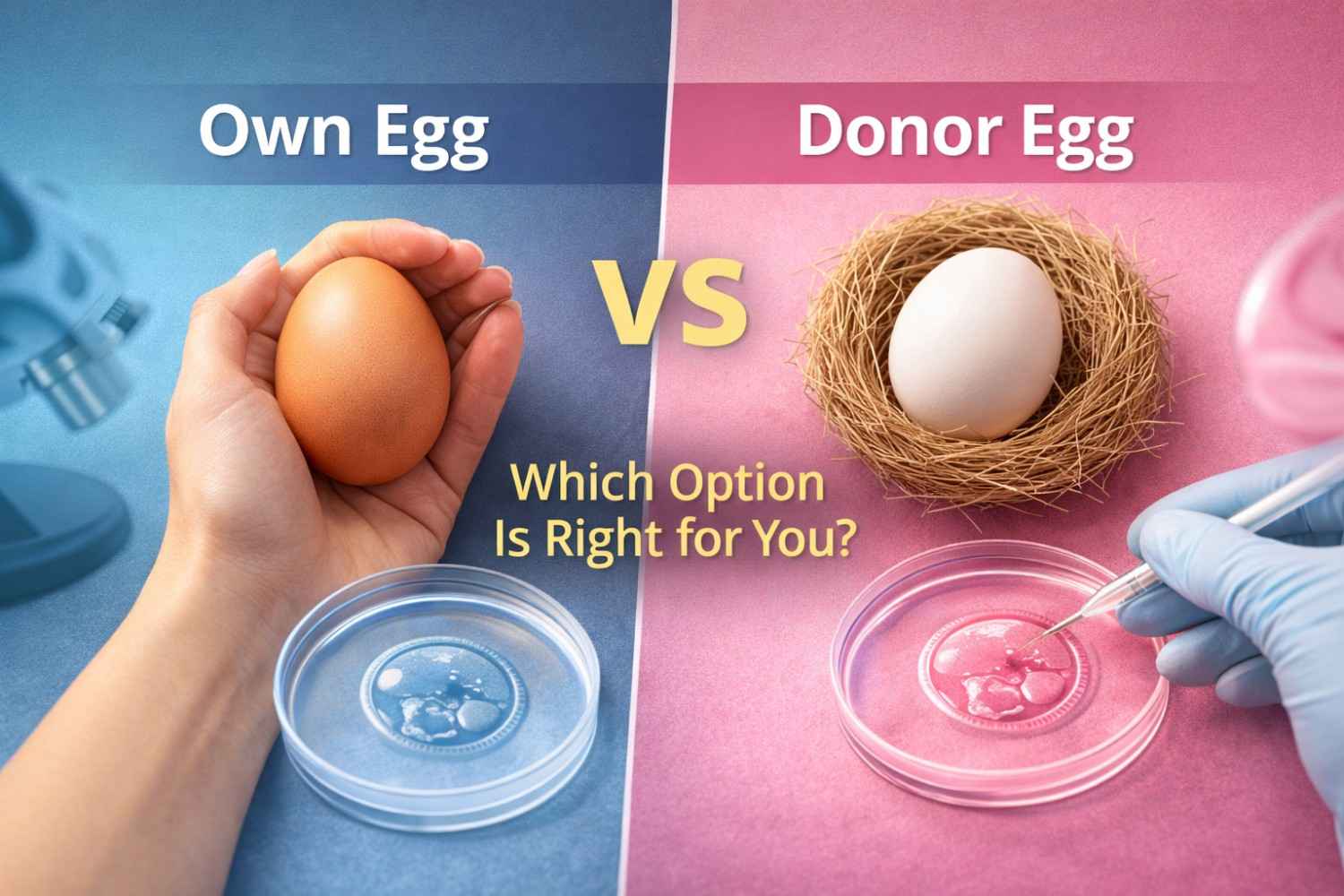
IVF with Own Egg vs Donor Egg: If you’re reading this, chances are you’re standing at a very difficult crossroads. I’ve sat across from couples in clinics in Delhi, Mumbai, London, and even Chicago who all ask the same question: Should we continue with my own eggs, or move to donor eggs?
This is not just a medical decision. It touches identity, expectations, finances, family pressure, and sometimes grief. So instead of giving you textbook explanations, I’m going to walk you through this the way doctors and patients actually experience it.
IVF with Your Own Eggs: What It Really Means
When you use your own eggs, your ovaries are stimulated with medication to produce multiple follicles. The eggs are retrieved, fertilized in the lab, and one or more embryos are transferred back into your uterus.
On paper, this sounds straightforward. In reality, the biggest factor is egg quality, and that’s where age plays a major role.
In my experience, IVF with own eggs works best when:
-
You are under 38 (sometimes up to 40 depending on ovarian reserve)
-
Your AMH and antral follicle count are reasonable
-
You haven’t had repeated failed cycles
-
There are no major chromosomal concerns
Many women assume that regular periods mean healthy eggs. That’s not always true. I’ve seen patients with perfect cycles but very poor embryo quality. Testing matters more than assumptions.
The emotional advantage? The child will carry your genetic material. For many families, especially in India where genetics are often emphasized culturally, that connection feels deeply important.
But here’s the hard part: after 40, success rates drop sharply with own eggs. Some clinics won’t say this directly, but they know it.
Read This Also: How Many IVF Cycles Are Needed to Get Pregnant – Expert Guide
IVF with Donor Eggs: When Doctors Suggest It
With donor egg IVF, the eggs come from a younger, screened donor. The embryos created are then transferred into your uterus. You carry the pregnancy.
Medically, this option is usually discussed when:
-
You are over 40 with low ovarian reserve
-
AMH levels are very low
-
Multiple IVF attempts have failed
-
There is premature ovarian failure
-
There are genetic risks you want to avoid
From what I’ve observed, donor eggs often significantly improve pregnancy chances for older women. The reason is simple: egg quality matters more than almost anything else in IVF.
But emotionally, this can feel heavy. Some women need time to process the idea that the baby will not share their DNA. That emotional processing is normal and healthy. Rushing it can lead to regret later.
Read This Also: iPhone 17 Pro Max Resale: लॉन्च के महीनों में नंबर 1! जाने क्यों?
A Simple Comparison You Can Think Through
| Factor | Own Eggs | Donor Eggs |
|---|---|---|
| Genetic Link | Yes | No (to mother) |
| Success After 40 | Lower | Usually higher |
| Emotional Adjustment | Usually easier | May need counseling |
| Cost | High | Often higher |
| Time to Start | Faster | May depend on donor match |
No table can decide for you, but clarity helps.
Real Mistakes I’ve Seen Couples Make
1. Trying too many cycles with poor egg quality
Some couples go through 4–5 emotionally draining cycles before accepting medical reality. If embryos are repeatedly poor quality, have an honest discussion early.
2. Switching to donor eggs without emotional readiness
Just because it improves odds doesn’t mean you are ready. I’ve seen couples rush, then struggle emotionally later.
3. Ignoring legal differences
In the UK, donor anonymity rules differ from the US. India has specific ART regulations. Always check the legal framework before proceeding.
Questions You Should Ask Yourself (Checklist)
Before making a decision, pause and reflect:
-
Have I had proper ovarian reserve testing?
-
Has my doctor clearly explained success chances for my age?
-
Am I emotionally ready for donor eggs if needed?
-
Are we financially prepared for more than one cycle?
-
Have we considered speaking to a fertility counselor?
If you can’t answer these confidently, slow down.
What Doctors Don’t Always Say Clearly
IVF is not just about pregnancy rates. It’s about sustainability — emotionally, physically, financially.
I’ve seen couples achieve pregnancy with donor eggs and feel deeply grateful. I’ve also seen women insist on using their own eggs because they needed closure, even if the odds were lower.
Neither choice is wrong. But clarity is essential.
Final Thoughts
There is no “better” option — only the one that fits your medical reality and emotional comfort.
Using your own eggs preserves genetic connection but may carry age-related limitations. Donor egg IVF often increases chances later in life but requires emotional acceptance.
Take your time. Ask uncomfortable questions. Don’t let clinic timelines or family pressure rush you.
This journey is personal.
FAQs
1. Is donor egg IVF more successful?
For women over 40, yes, success rates are usually higher because egg quality is stronger.
2. Will I bond with a baby conceived from donor eggs?
Most women do. Pregnancy itself creates a strong biological and emotional bond.
3. Can I try my own eggs first?
Yes, many couples do one or two cycles before considering donor eggs, depending on medical advice.
4. Is donor egg IVF legal in India, the US, and the UK?
Yes, but regulations differ. Always confirm clinic compliance with local ART laws.
5. Is donor egg IVF more expensive?
Generally yes, due to donor screening, compensation, and coordination costs.
6. How do I know if my egg quality is low?
Doctors evaluate AMH levels, ultrasound follicle count, and previous IVF response. No single test tells the whole story.