


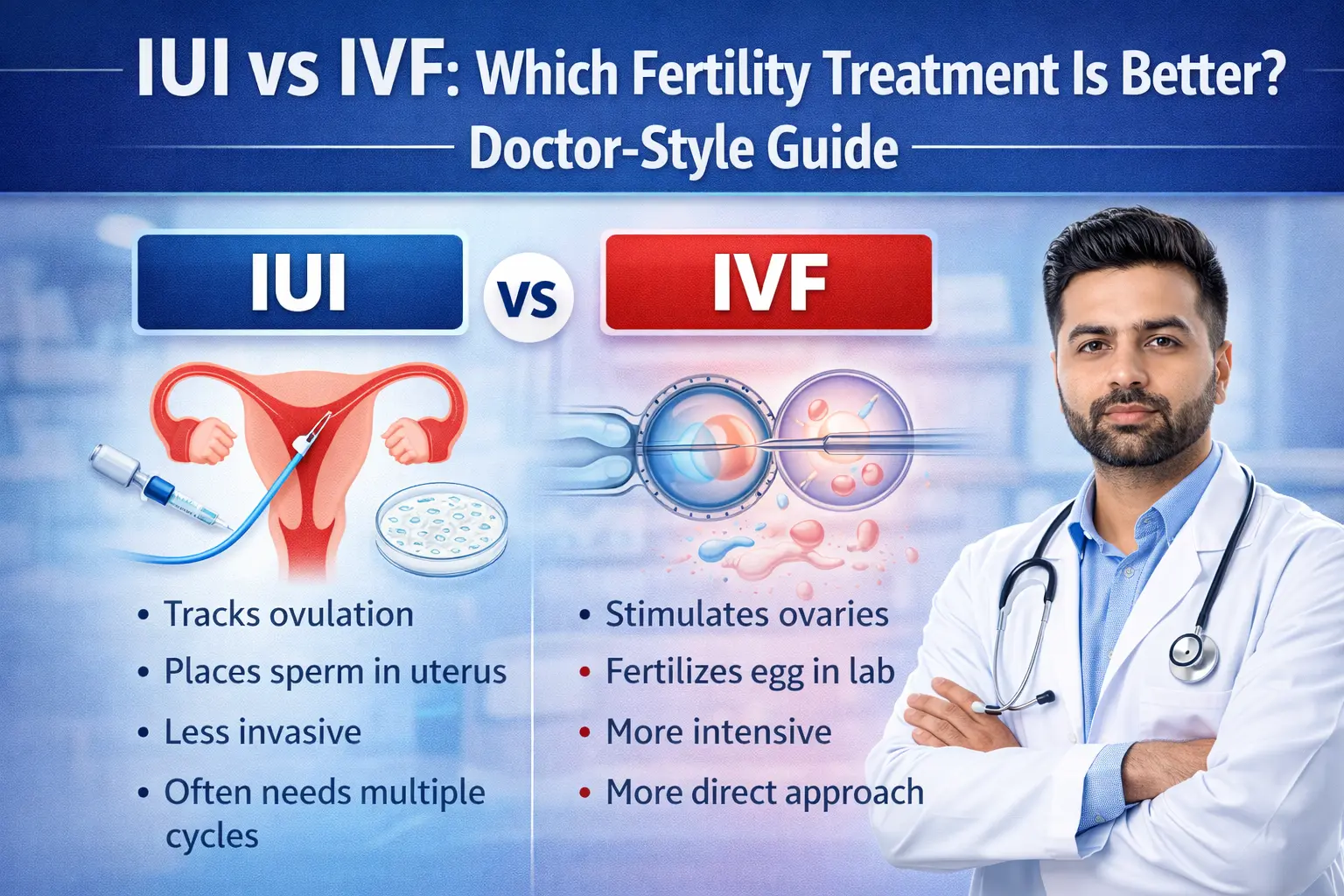
If you’re comparing IUI vs IVF, you’re probably not looking for definitions—you’re trying to make a decision that affects your time, money, emotions, and family plans.
I’ve seen the same pattern with couples in India and also those in the US/UK (including NRIs): people start with “let’s try the simpler option first,” and then lose months because no one explained when IUI is actually worth trying—and when IVF is the smarter move from day one.
Read This Also: IVF Cost in India 2026: What Is IVF, Full Process & City Wise Price List
First, what IUI and IVF really mean in real life (not textbook)
IUI (Intrauterine Insemination) — what it’s like on the ground
IUI is basically: tracking ovulation → preparing sperm → placing sperm inside the uterus at the right time.
In many clinics, it’s treated like a “light” fertility step:
-
fewer injections (sometimes none)
-
fewer procedures
-
lower cost
-
less emotional/physical load
But IUI also depends heavily on timing and biology cooperating. If the eggs, tubes, sperm, or ovulation window aren’t working well, IUI becomes a repeated “maybe” cycle.
Read This Also: Small Bathroom Ideas 2026: Tiny Space Makeover That Feels Big
IVF is: stimulating ovaries → collecting eggs → fertilizing in lab → growing embryos → transferring one embryo.
It’s more intense:
-
more scans, injections, planning
-
higher cost
-
bigger emotional investment per cycle
But IVF gives doctors more control:
-
you bypass tube issues
-
you can handle low sperm issues more effectively (often with ICSI if needed)
-
you can sometimes create multiple embryos in one retrieval and do transfers later
“Which is better?” is the wrong first question — ask this instead
From experience, the best decision starts with:
1) “What is actually causing the delay in pregnancy?”
Not every couple needs IVF. But also—many couples are pushed into IUI repeatedly even when the real issue makes IUI unlikely.
2) “How much time can we realistically give this?”
This is huge for:
-
age factor
-
long infertility history
-
career/visa/relocation timelines (very common in US/UK couples)
3) “Are we okay with trial-and-error, or do we want a more direct approach?”
IUI often means multiple tries. IVF often means fewer but bigger tries.
The practical decision guide: When IUI makes sense
IUI is usually considered when the basics are reasonably okay:
IUI is often a reasonable first step if:
-
fallopian tubes are open
-
ovulation is happening (or can be supported with mild meds)
-
sperm count/motility is not severely low
-
infertility duration is not very long
-
age is not strongly against waiting
Real-world example I’ve seen often:
A couple with mild PCOS and decent sperm parameters can do 2–3 well-timed IUIs instead of jumping to IVF immediately—as long as they’re tracking properly and not guessing cycles.
When IVF is usually the smarter choice (even if IUI feels “simpler”)
IUI fails most when the problem is structural or severe.
IVF is often preferred if:
-
both tubes are blocked or damaged
-
endometriosis is moderate to severe (case-by-case, but often IVF is faster)
-
sperm parameters are significantly low (or repeated poor semen reports)
-
ovarian reserve is low (waiting can cost valuable time)
-
age is a major factor (especially mid/late 30s and beyond)
-
you’ve already tried multiple IUIs with no success
-
unexplained infertility with long duration (depends, but IVF may give answers + better odds)
What people don’t realize:
Sometimes IVF is chosen not because it’s “better,” but because it stops wasting time when the biology is clearly not cooperating with IUI.
The part clinics don’t always explain: IUI success depends on “quality of the cycle”
IUI isn’t just “do it and hope.” The quality matters:
A good IUI attempt usually includes:
-
proper follicle monitoring (not guessing ovulation)
-
correct timing for insemination
-
an appropriate trigger (if needed)
-
sperm preparation done properly
-
realistic number of cycles planned before starting
Common mistake I see:
Couples do IUI repeatedly without a clear cutoff—no plan like “we’ll do 3 cycles, then reassess.” It becomes endless.
IUI vs IVF comparison table (save this)
| Factor | IUI | IVF |
|---|---|---|
| Invasiveness | Low | Higher (procedures + injections) |
| Cost | Lower | Higher |
| Clinic visits | Fewer | More |
| Works well for | Mild issues, timing problems, mild male factor | Tubal issues, severe male factor, low reserve, repeated failures |
| Time to try | Often needs multiple cycles | Often fewer cycles, but each is bigger |
| Lab involvement | Minimal | High (fertilization + embryo culture) |
| Emotional load | Usually lighter per cycle | Heavier per cycle |
| “Control” over variables | Lower | Higher |
A simple decision workflow (use this with your doctor)
If I were guiding a friend, I’d ask them to follow this exact workflow:
Step 1: Confirm the basics (don’t skip this)
-
semen analysis (repeat if borderline)
-
ovulation confirmation
-
tube check (HSG or recommended method)
-
uterine evaluation if indicated
Why it matters:
If tubes are blocked, IUI may be pointless. If sperm is severely low, IUI may be wasted effort.
Step 2: Decide your IUI “trial limit” before starting
A practical approach many couples use:
-
2–3 IUIs if it’s a good IUI case
-
then stop and reassess
Why it matters:
It prevents the “we’ve done 6 IUIs and now we’re tired and broke” situation.
Step 3: If IVF is likely, don’t delay for emotional comfort alone
It’s normal to fear IVF. But if your case strongly points to IVF, delaying doesn’t make IVF easier later—sometimes it makes it harder.
Step 4: Protect your mental bandwidth
Plan your cycles around:
-
work travel
-
family events
-
support system
-
recovery time
This matters even more for US/UK couples flying to India for treatment—tight travel windows need tight planning.
Real-life mistakes I see (and how to fix them)
Mistake 1: Choosing IUI because it’s cheaper—without checking if it fits
Fix: Decide based on diagnosis + time, not only cost.
Mistake 2: Doing IUI with poor monitoring
Fix: Ask how many scans are planned and how timing is decided.
Mistake 3: “Unexplained infertility” becoming a parking lot
Fix: Ask what the next step will be if 2–3 IUIs fail.
Mistake 4: Ignoring male factor because “everything looks okay”
Fix: If semen results fluctuate, repeat testing and ask if ICSI might be needed in IVF.
Mistake 5: Not discussing the emotional toll upfront
Fix: Set expectations: injections, waiting period, result anxiety—plan support in advance.
Key takeaway
IUI is not “worse” and IVF is not “better” by default.
IUI is best when the situation is truly suitable and time allows. IVF is best when the biology or timeline demands a more controlled approach.
If you want one sentence to remember:
Choose IUI when the basics are strong and you can afford a few tries. Choose IVF when time or diagnosis makes “a few tries” a costly delay.
FAQs (real doubts people ask)
1) How many IUI cycles should we try before IVF?
Many couples set a limit of 2–3 properly monitored IUIs, then reassess. More may be reasonable in some cases, but only with a clear reason.
2) Is IVF always faster than IUI?
Not always. IVF involves more steps and planning. But when IUI is unlikely to work, IVF can be faster overall because it reduces repeated failed cycles.
3) Which is more painful—IVF or IUI?
IUI is usually much easier physically. IVF involves injections and egg retrieval (usually under anesthesia/sedation), so it’s more intense.
4) Can we do IVF directly without trying IUI?
Yes, and for many diagnoses it’s sensible. The “you must do IUI first” idea is not always medically necessary—it depends on your case.
5) What if all reports are normal but pregnancy isn’t happening?
That’s often called unexplained infertility. In such cases, doctors may try IUI first, but IVF may be considered sooner if time is a concern.
6) Is IUI useful for low sperm count?
It depends how low and what exactly is low (count, motility, morphology). Mild male factor may work with IUI; more severe issues often do better with IVF/ICSI.
7) Does IVF guarantee pregnancy?
No. IVF improves control and can improve chances in many cases, but it’s not a guarantee. Any clinic promising certainty is not being honest.
8) Can US/UK couples come to India for IVF/IUI?
Yes, many do. The important part is planning: time for scans, retrieval/transfer schedule, and what follow-up looks like after you fly back.
9) Is IVF always more expensive than IUI?
Yes, usually. But repeated IUIs can also add up—especially if they’re not well-indicated or go on for too many cycles.
10) What should I ask my doctor in one minute?
Ask these three:
-
“What’s our diagnosis and what does it mean for IUI vs IVF?”
-
“If we choose IUI, how many cycles before we change plan?”
-
“What’s the biggest reason it might fail in our case?”