


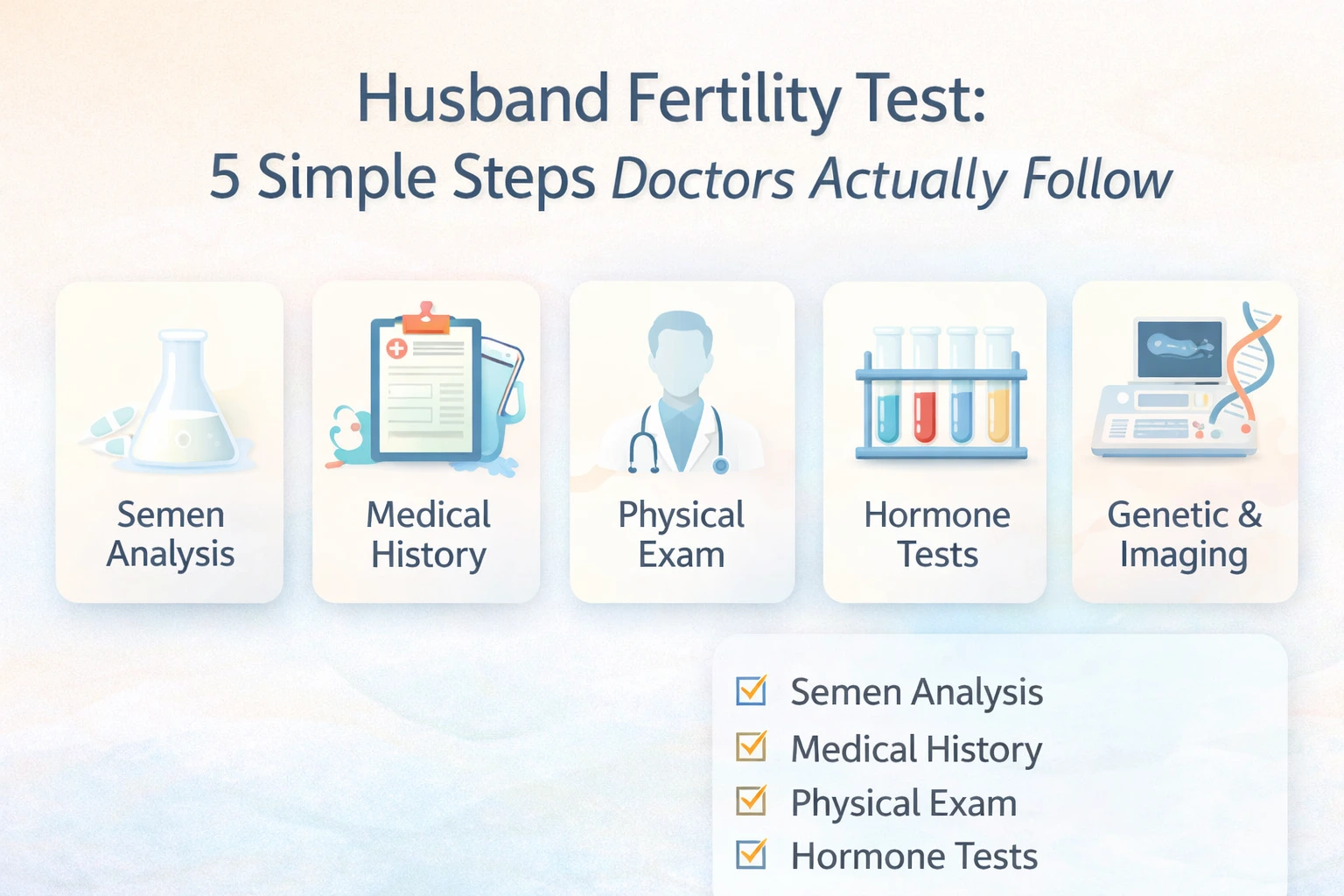
Husband Fertility Test: This guide is for couples who are trying to get pregnant and feel confused about where to begin—especially women who usually take the lead in medical visits, and men who are unsure what fertility testing actually means for them. What I’m sharing here comes from how fertility testing is handled in real clinics and the questions couples commonly ask, not from textbook definitions.
Why testing the husband’s fertility is important (and often postponed)
In most households, fertility checks begin with the woman. I’ve seen many couples spend months—sometimes longer—going through scans and blood tests before anyone suggests checking the husband. This delay often adds stress and frustration because male-related factors are just as common.
Testing the husband early doesn’t mean blaming anyone. It simply helps you understand the situation faster so decisions can be made with clarity instead of guesswork.
Another reason this step is important: male fertility tests are usually easier, quicker, and less invasive. Often, a single basic test already points doctors in the right direction.
Step 1: Semen analysis – where everything starts
What this test does
A semen analysis looks at the sperm present in a sample provided by the husband. It’s usually the first and most important test in male fertility evaluation.
Why doctors rely on it
For pregnancy to happen, sperm need to be present in adequate numbers, move properly, and have a healthy structure. Even if everything else is normal, issues in these areas can slow or prevent conception.
What the lab typically checks
Sperm count: Total number of sperm
Motility: How actively sperm move
Morphology: Shape and structure of sperm
Volume and liquefaction: Basic indicators of semen health
How the sample is collected
The sample is usually given through masturbation, either at the lab or at home (if it reaches the lab within the recommended time). Most doctors advise avoiding ejaculation for 2 to 5 days before the test so results are reliable.
From real-world practice:
One report doesn’t always tell the full story. Doctors often ask for a repeat test after 2–3 weeks to see if the results are consistent.
Step 2: Medical history and physical check-up
If the semen report shows issues—or sometimes even if it looks normal—the doctor may ask a few detailed questions and do a basic physical examination.
This usually covers
Past illnesses like mumps or sexually transmitted infections
Surgeries during childhood, especially hernia or testicular surgery
Regular exposure to heat (sauna use, laptop on lap for long hours)
Alcohol intake, smoking, steroids, or gym supplements
Checking testicular size and veins to rule out conditions like varicocele
Why this step matters
Some fertility problems are treatable, but only if they’re identified early. Skipping this step can mean missing simple solutions.
Step 3: Hormone tests (only if required)
Hormone testing is not done for everyone. Doctors usually suggest it when sperm count is very low or completely absent.
Common hormones tested
Testosterone
FSH (Follicle-Stimulating Hormone)
LH (Luteinizing Hormone)
Prolactin (in selected situations)
What these tests explain
They help doctors understand whether the body is producing sperm properly or if there’s a communication problem between the brain and the testes.
Step 4: Genetic tests (for selected cases)
Genetic testing is not routine and isn’t advised for most men. It’s usually suggested when:
Sperm count is extremely low or zero
There have been repeated IVF failures
There’s a known genetic condition in the family
This helps doctors decide which treatment options make sense and what expectations should realistically be set.
Step 5: Imaging tests (when needed)
In some cases, doctors recommend an ultrasound to look for:
Varicocele (enlarged veins)
Blockages
Structural problems
These tests are painless and usually take very little time.
A simple fertility-testing checklist for husbands
You can keep this handy:
Semen analysis completed (ideally twice)
Correct abstinence period followed
Medical history discussed openly
Lifestyle habits reviewed honestly
Hormone tests done if advised
Follow-up visit planned
Common mistakes couples make (and how to avoid them)
Mistake 1: Trusting a single “normal” report
Fix: If pregnancy hasn’t happened after 6–12 months, repeat the test. Sperm quality can change.
Mistake 2: Underestimating lifestyle effects
Smoking, excess alcohol, poor sleep, and supplements affect sperm over months, not days.
Mistake 3: Taking fertility supplements blindly
Many supplements are unnecessary. Testing first prevents wasted money and false hope.
Mistake 4: Linking fertility with masculinity
This mindset delays testing. Fertility issues are medical conditions, not personal shortcomings.
How long does it take to see improvement?
Any change—medicine, surgery, or lifestyle—takes about three months to reflect in semen reports. Sperm production follows a cycle, so improvement is gradual, not instant.
Key takeaway
Testing a husband’s fertility is simple, respectful, and extremely useful when trying to conceive. Doing it early saves time, emotional stress, and unnecessary procedures. If pregnancy is being planned and male fertility hasn’t been checked yet, that’s often the most sensible place to begin.
Read This Also: What to Do to Improve Fertility – Food & Daily Routine Guide
Frequently Asked Questions
1. What is a husband fertility test?
A husband fertility test checks sperm health through semen analysis. It evaluates sperm count, movement, and structure to understand possible causes of delayed pregnancy.
2. When should a husband fertility test be done?
A husband fertility test is advised if pregnancy hasn’t happened after 6–12 months of trying, or earlier if the woman is over 30 or cycles are irregular.
3. Which test is most important in husband fertility testing?
Semen analysis is the most important husband fertility test. It usually gives doctors enough direction for further evaluation or treatment.
4. How long does it take to see improvement after testing?
Any improvement in husband fertility test results usually takes around three months after treatment or lifestyle changes.
5. Can lifestyle changes improve husband fertility test results?
Yes, in many mild cases, quitting smoking, reducing alcohol, better sleep, and stress control can improve husband fertility test reports over time.
If semen reports are abnormal, pregnancy hasn’t occurred after reasonable time, or guidance is needed for next steps.