


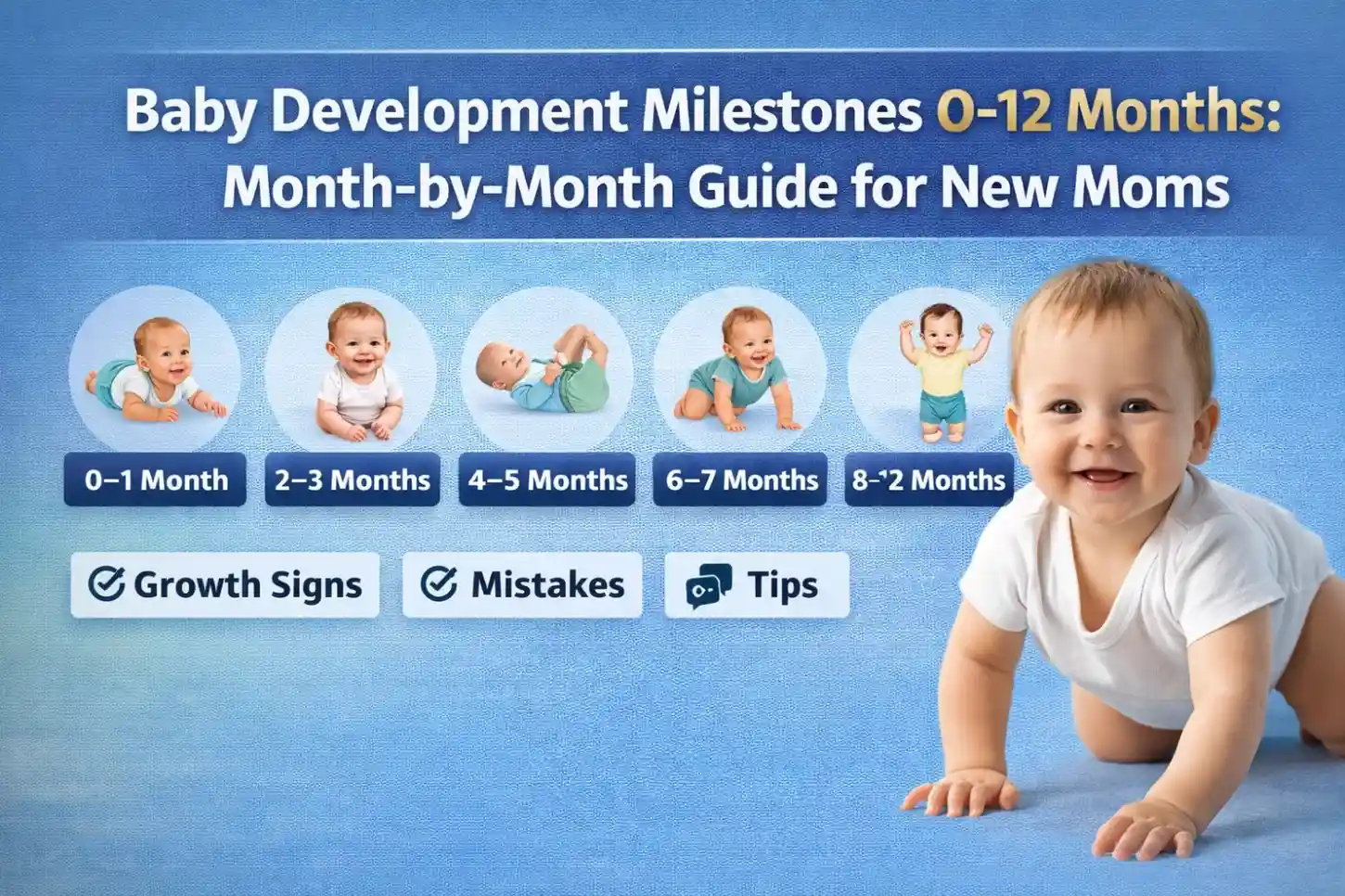
Baby Development Milestones 0–12 Months: The hardest part of the first year isn’t just the sleepless nights—it’s the constant question in your head: “Is my baby developing normally?” I remember staring at other babies in the family and wondering why mine wasn’t doing the same thing yet. This guide is for new mothers who want clear, realistic milestones from 0 to 12 months, plus what to do at home and when to avoid panic. Babies don’t follow a single timeline, so think of milestones as a range, not a test.
How to use this milestone guide (so it doesn’t stress you out)
-
Look for steady progress, not perfection.
-
Compare your baby only to their previous week, not to someone else’s baby.
-
A baby can be ahead in movement and slower in speech (or the opposite). That’s common.
Month-by-month milestones (0–12 months)
Month 0–1: “Waking up to the world”
What you may notice: brief eye contact, startle reflex, turning toward voices, tiny head lifts during tummy time.
Why it matters: these are early signs your baby’s senses and nervous system are switching “on.”
Home tip: 1–2 minutes of tummy time after diaper changes is enough to start.
Month 2: Smiles and smoother movement
What you may notice: social smiles, calmer stretches, hands opening more, tracking faces.
Common mistake: expecting laughter already. Smiling often comes before giggles.
Home tip: talk during routine care—diaper, bath, feeds. Babies learn from repetition.
Month 3: Stronger neck + more “chat”
What you may notice: better head control, cooing, pushing up on forearms, noticing hands.
Why it matters: stronger neck control sets up rolling later.
Home tip: use a rolled towel under the chest during tummy time if baby hates it.
Month 4: Rolling attempts and big reactions
What you may notice: rolling (often tummy-to-back first), reaching for toys, squeals, louder babbling.
Safety note: if your baby starts rolling, treat every surface like a fall risk.
Month 5: Grabbing everything
What you may notice: bringing objects to mouth, transferring toy hand-to-hand, laughing, recognizing familiar people.
Real-life issue: drooling increases—many parents assume teething. It can be normal drool too.
Home tip: offer safe teethers and keep small objects out of reach.
Month 6: Sitting starts + solid foods begin (for many babies)
What you may notice: sitting with support, rolling both ways (some babies), responding to name, stronger babbling.
Feeding note: if you start solids, think tiny tastes, not full meals. Milk remains primary.
Common mistake: adding salt/sugar early. Keep food simple.
Month 7: More movement and stranger awareness
What you may notice: sitting more steadily, pivoting on tummy, “stranger danger,” exploring textures.
Why it matters: emotional development shows up here—babies become selective about people.
Month 8: Crawling styles + understanding routines
What you may notice: crawling (or rocking, scooting), pulling to stand with support, playing peekaboo, “mamama/bababa” sounds.
Reminder: some babies skip crawling and move to standing/walking later. That can still be normal.
Month 9: Pulling up and true “communication”
What you may notice: pulling to stand, cruising along furniture, waving/clapping, pointing, understanding “no” (even if they ignore it).
Home tip: baby-proof low shelves—this is the month everything becomes a target.
Month 10: Busy hands, busy feet
What you may notice: pincer grasp (thumb + finger), feeding self finger foods, copying sounds, standing briefly.
Common mistake: giving hard foods (nuts, grapes, popcorn). Cut foods small and soft to reduce choking risk.
Month 11: Practice, practice, practice
What you may notice: cruising confidently, simple gestures, understanding familiar words, showing preferences strongly.
Why it matters: the brain is connecting movement + intention—this is big for independence.
Month 12: First birthday, new skills
What you may notice: first steps (or close), 1–3 simple words (varies), following simple directions, pointing to show interest.
Important: some babies walk at 9 months, others at 15 months. Both can be okay if progress continues.
Copy-and-save checklist (monthly quick check)
Use this once a month:
-
Baby makes eye contact and reacts to your voice
-
Baby shows growing control of head and body
-
Baby uses hands more (reaching, grabbing, transferring)
-
Baby explores with mouth safely (supervised)
-
Baby becomes more social (smiles, laughs, responds)
-
Baby’s movement progresses (rolling → sitting → crawling/standing)
-
Baby’s communication grows (coos → babble → gestures → words)
Real-life mistakes I see often (and easy fixes)
-
Mistake: comparing to other babies weekly.
Fix: compare to your baby’s last month. Small changes count. -
Mistake: skipping tummy time because baby cries.
Fix: do short sessions, more often—after diaper changes works well. -
Mistake: rushing solids to “help baby sleep.”
Fix: focus on a calming bedtime routine; solids don’t reliably improve sleep. -
Mistake: giving walkers to speed up walking.
Fix: floor time + safe cruising space is better for coordination.
Takeaway
Your baby’s first year is less about hitting exact dates and more about steady, unfolding progress. If something feels off, you’re not “overthinking”—you’re paying attention. Keep a simple routine, watch for growth over weeks, and trust your instincts.
FAQs (real doubts new mothers ask)
Q1. What are baby development milestones 0–12 months?
Baby development milestones 0–12 months describe the physical, emotional, and communication skills babies usually develop during their first year, such as rolling, sitting, babbling, and standing.
Q2. Is it normal if a baby is late in some milestones?
Yes. Baby development milestones 0–12 months vary widely. What matters most is steady progress over time, not hitting exact dates.
Q3. Do all babies crawl before walking?
No. Some babies skip crawling and move straight to standing or walking. This can still fit within normal baby development milestones 0–12 months.
Q4. How many words should a 12-month-old say?
Many babies say 1–3 words by 12 months, but gestures and understanding simple commands are also important baby development milestones 0–12 months.
Q5. When should parents worry about missed milestones?
If a baby shows no progress for months, loses skills, or avoids interaction, parents should discuss baby development milestones 0–12 months with a pediatrician.
Read This Also: Best Time for Pregnancy: Right Age, Right Days & Common Mistakes